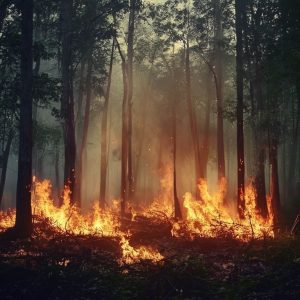
 Forest fires, which have been rather rare and low-intensity in Central Europe for decades, may become more frequent and severe in the future. According to German expert Matthias Forkel of the Technical University of Dresden, the region needs to prepare for conditions that are now more common in southern Europe.
At the Interreg CE Clim4Cast project conference in Prague, Forkel described the 2022 fire in the Bohemian and Saxon Switzerland National Park as a major turning point, which he said was a wake-up call for the entire region. At that time, the fire also created rare so-called pyrocumulus clouds, and smoke could be smelled for tens of kilometres, including Prague. It was the largest forest fire ever in Czechia.
According to Forkel, climatic conditions are changing fundamentally. Extreme fire weather – a combination of drought, high temperatures and high winds – is increasing faster in central Europe than predicted by older climate models. By the end of the century, the number of days with high fire risk could increase by ten to twenty a year, he believes. “This means significantly higher demands on the preparedness of forest managers and emergency services,” he warned.
Burnt areas are not yet increasing
Miroslav Trnka, a bioclimatologist from the Institute of Global Change Research of the CAS (CzechGlobe), has a similar assessment. According to him, the number of fire incidents is slightly increasing globally and in Czechia. At the same time, data from most European countries do not show an increase in the total area burned, which may seem like a contradiction, he mentioned.
Trnka pointed out that the reason for this is primarily the increasing efficiency and speed of interventions. “Today we extinguish fires faster than in the past, we have better equipment, more experience and at the same time less use is made of economic practices that used to work with fire. There are also fewer fires in general than in the past,” Trnka said.
However, the negative trend, according to him, is the prolongation of the period when conditions are suitable for the start and spread of fires. There are more days with hot and dry weather, and the moisture content of forest fuel is decreasing, increasing the overall exposure of the landscape to fire risk.
According to scientists’ estimates, Czechia and other parts of Central Europe will experience more large-scale fires in the coming decades than in the past. Meteorological conditions and the state of vegetation will be so much more favourable for the start and spread of fires that the positive trend in firefighting efficiency may be “overwhelmed by the climate signal”, according to Trnka. Forkel also pointed to other risk factors, such as bark beetle calamities or large amounts of dead wood, that can lead to more intense burning. According to both Forkel and Trnka, closer cooperation between scientists, forest managers, firefighters and municipalities, better cross-border coordination and more emphasis on prevention and public information, especially in high-risk areas, will be key in the future.